Paul Neagu
Generative Codes
Schedule
Saturday - 12:00 - 18:00
Sunday - 12:00 - 18:00
Copyright The Estate of Paul Neagu, All Rights Reserved, DACS, 2026; courtesy of the Ivan Gallery
Generative Codes
Copyright The Estate of Paul Neagu, All Rights Reserved, DACS, 2026; courtesy of the Ivan Gallery
The exhibition Paul Neagu. Generative Codes is intended as a synthetic overview of Paul Neagu’s trajectory, from his experiments with tactile art initiated in Romania and continued in the United Kingdom, to the construction of complex artistic systems expressed through drawing, object, performative actions, and later on, sculpture. Paul Neagu is an experimental artist who created expansive constellations of works, infused by the aspiration to attain unity through “open axiomatic” artistic formulas. He regarded art as a vector of communication and convergence, and was intensely concerned with the physical, material concreteness of artistic expression, in conjunction with the many philosophical and spiritual inquiries he attached to the subjects he explored. The exhibition proposes an immersion into Neagu’s theoretical and formal universe, presenting all the media he worked in, and the stages of his trajectory, with a particular focus on a dimension central to his practice: the expressive formulas that evoke those akin to ritual, understood both as a communicational relay—a means of sharing collective experiences—and as a way of reaching inter- and trans-subjective states deemed to be endowed with cosmological and metaphysical overtones.
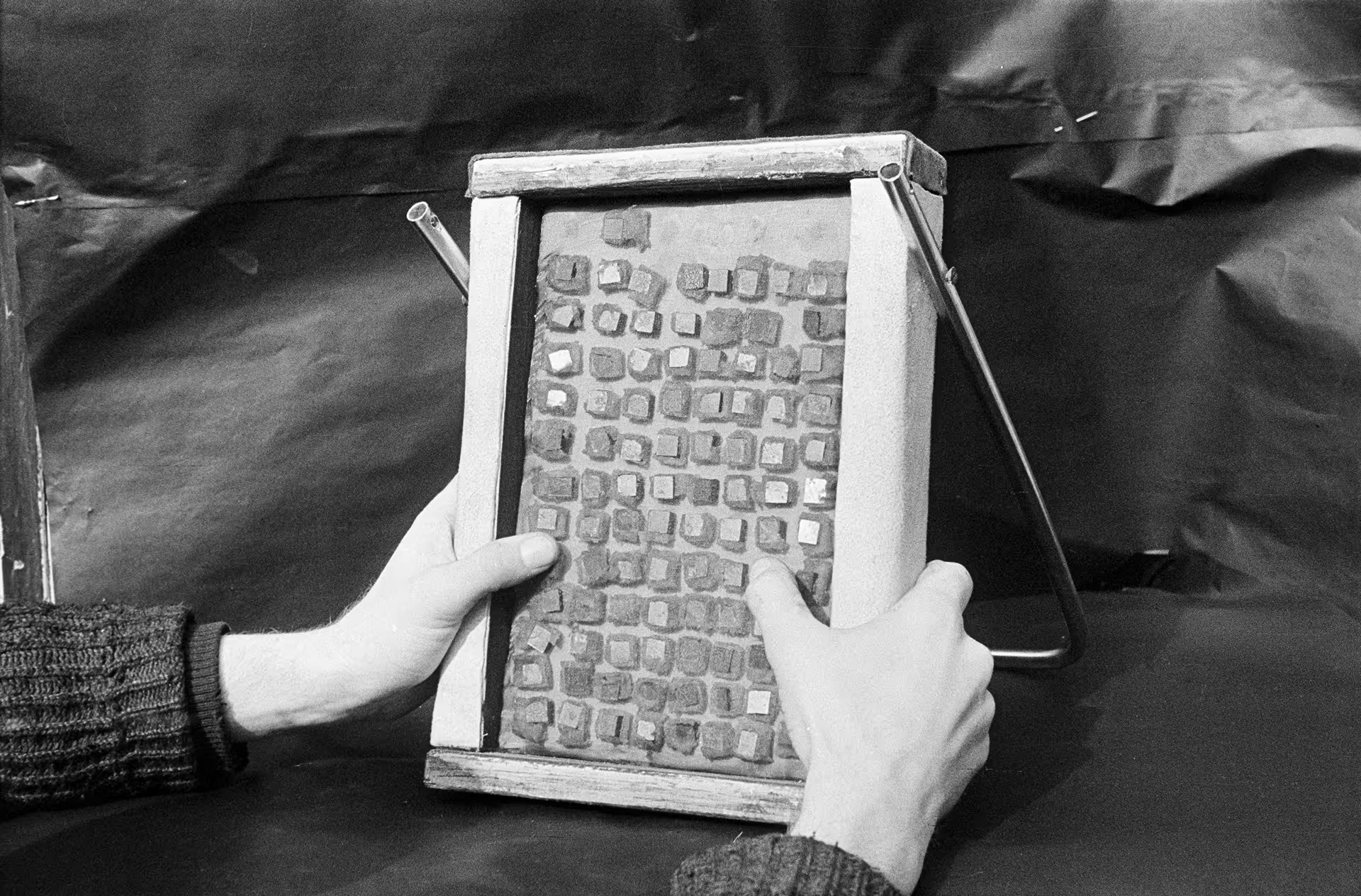
From the very beginning of his trajectory, Neagu devised objects intended to interact with their environment, placing them in public spaces in Bucharest or staging demonstrations that resorted to the gestural repertoire of a magic show. When included in performative sequences, these “boxes” are opened to reveal their interior compartments, consisting in reticular structures, enigmatic objects, and kaleidoscopic arrangements. Immediately succeeding this phase, encouraged by his contact with the international art scene, Paul Neagu composed the Palpable Art Manifesto, in which he advocated for the reactivation of all the senses in the perception of the surrounding world, and of “artistic products.” This direction in his work generated “the idea of the concrete, palpable object one can handle, tactile, portable, agreeable perhaps, or idiotically clumsy, but necessary as the everyday bread, as the love for each moment when one breathes”
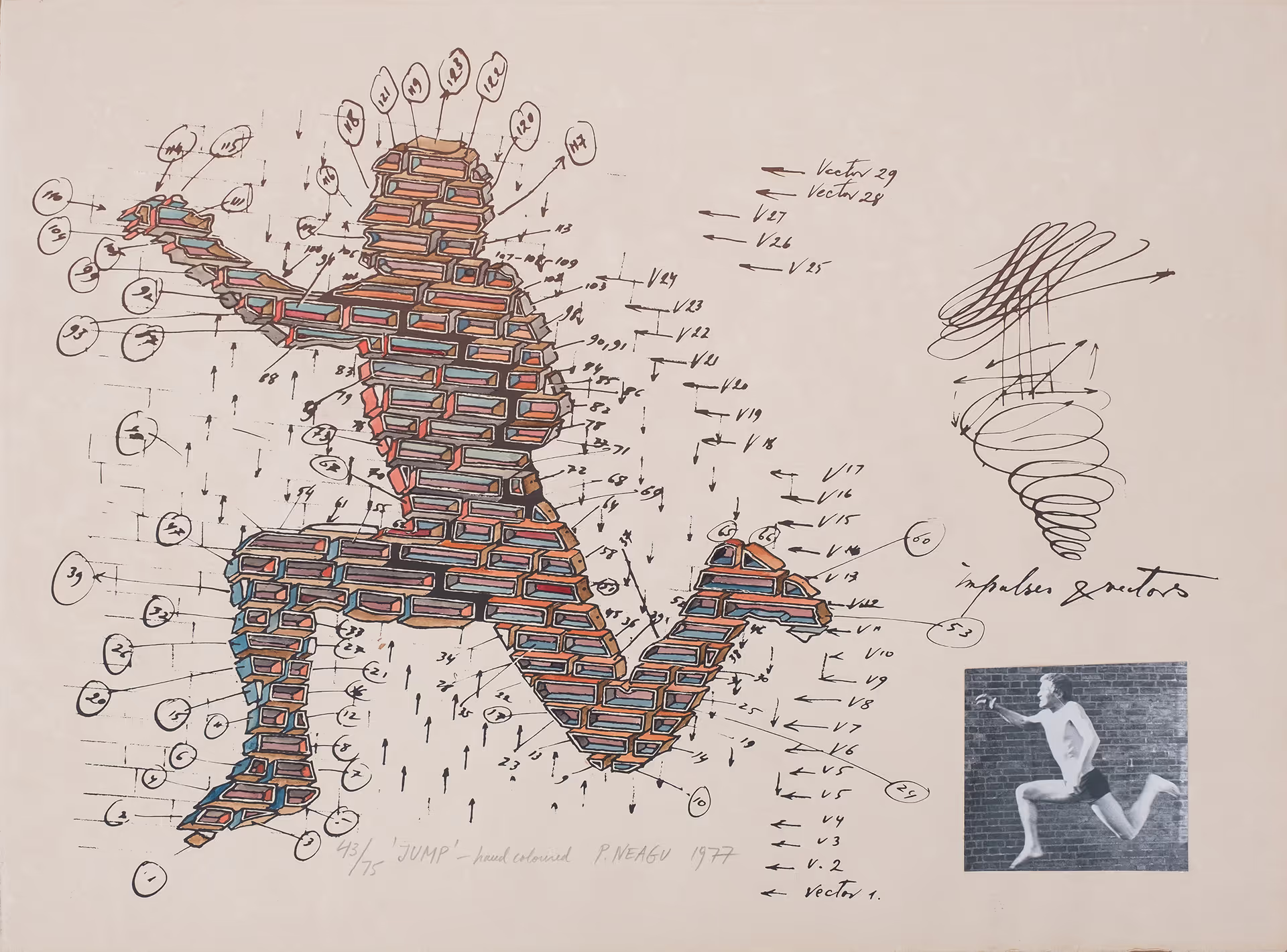
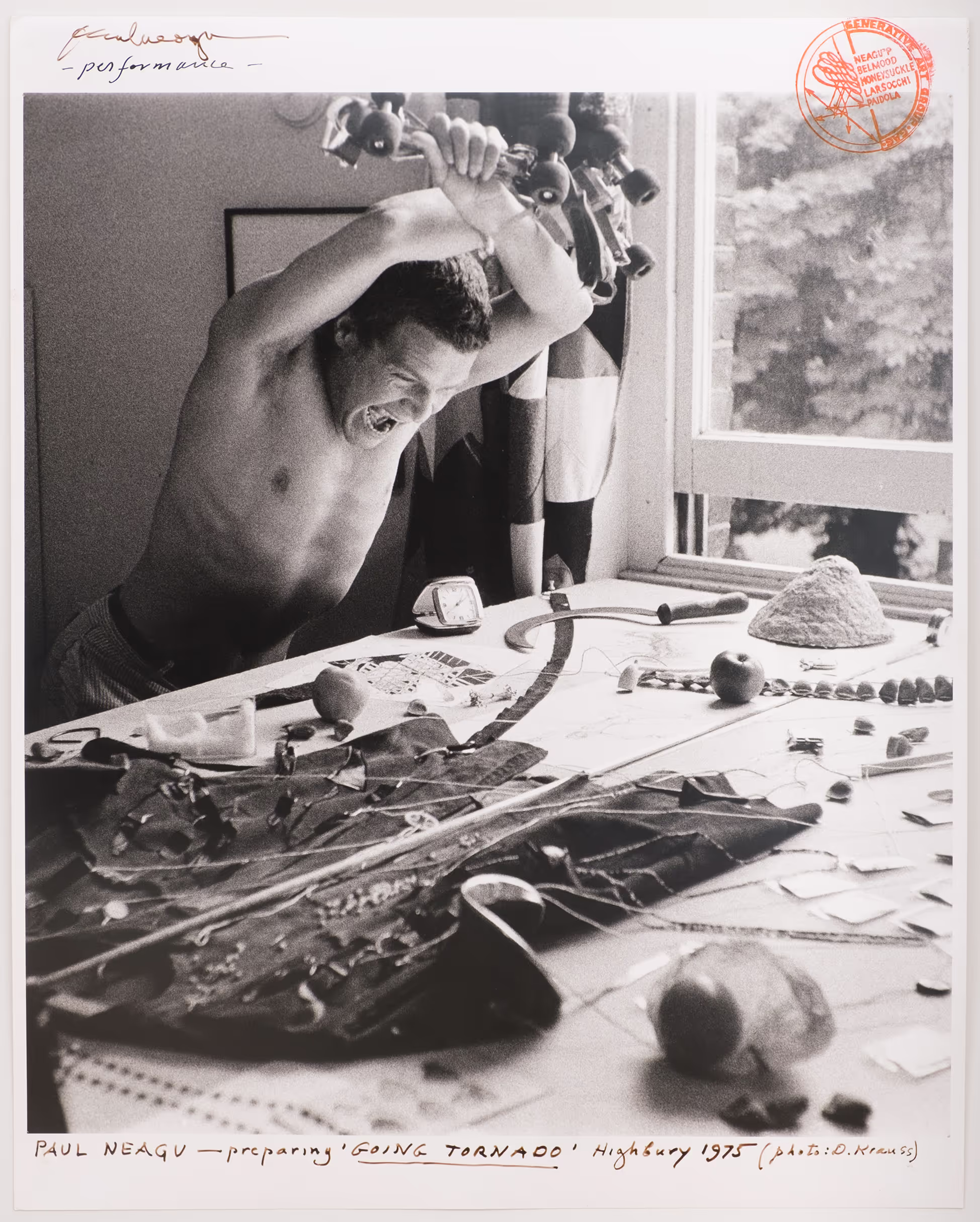
Overcoming the subject–object dichotomy is a concern further pursued through actions such as Cake Man, a happening organized shortly after Neagu’s relocation to London, in which the part–whole relationship is explored through the symbolic decomposition and re-composition of the human body, conceived as an aggregation of “cells.” Within this collective action, the cells—made of waffles, baked and assembled on site—are ritually consumed by the participants present at the event. The series of cellular drawings expands the inquiry into the dialectic of union and separation, highlighting the idea of totality, most vividly represented through numerous diagrams that present the human body as a unified whole. The fragmentation and reconstitution of this whole is further explored in Neagu’s most intense experimental phase, through the invention of the Generative Art Group, a fictive collective of artists, each with his own personality and mode of operation, engaged in various performative scenarios—individual or collective—exploring strategies of estrangement, anamorphic distortions, and metamorphoses.
This investigation of the relationship between fragmentation and unification, accompanied by the sporadic intrusion of what is perceived as esoteric “events”, is followed by an interest in the vocabulary of sculpture, inaugurated through Neagu’s major invention: the Hyphen signifying union and separation. The Hyphen, a tripod supporting a rectangular surface, incorporates within its formal structure the dynamism of the human body in its leap toward the transcendent. This entity represents the nodal point from which Neagu’s other sculptural projects develop, be it in two-or three-dimensional forms. The Nine Catalytic Stations are each endowed with their own dynamic vectors, distinct balances of forces, various materialities, and carefully calibrated alternations between solid and void. According to Neagu, they behave like living organisms, dancing or interacting, like an orchestra. As he once remarked, when gauging the subtly articulated spaces generated through their interrelation, these sculptures “started to speak on their own and to emanate a music, an energy unsuspected even by me, their “creator.”
Guided Tour
Only 25 spots available per tour
Explore the universe of Paul Neagu alongside Magda Radu, the curator of the exhibition “Generative Codes”
The tour offers an insight into the central themes and working processes that define Paul Neagu’s practice, inviting visitors to discover how drawing, sculpture, and performative action work together as forms of visual thinking and articulation of ideas.
Access is based on prior reservation. You will receive your access code by email and SMS.
9 May, Saturday
16:00 - 17:00 Guided Tour
17:00 - 18:00 Guided Tour
23 May, Saturday
12:00 - 13:00 Guided Tour
13:00 - 14:00 Guided Tour
Paul Neagu
Biography
Paul Neagu was born in 1938 in Bucharest, Romania. In 1946, his family moved to Timișoara, where he grew up and began his artistic journey. Between 1959 and 1965, he studied painting at the “Nicolae Grigorescu” Institute of Fine Arts in Bucharest. Before establishing himself as an artist, he worked as an electrician and a technical draughtsman—experiences that would later inform his conceptual and experimental approach to art.
In 1971, Neagu emigrated to England, becoming a British citizen in 1976. In London, he taught at Hornsey College of Art, The Slade School of Fine Art, and Chelsea College of Art and Design. That same year, he was appointed Associate Professor at the Royal College of Art, where his students included Antony Gormley, Anish Kapoor, Tony Cragg, and Perry Robinson, thus contributing to the formation of a defining generation of British contemporary sculpture and conceptual art.
Paul Neagu’s works are held in prestigious collections worldwide, including The British Museum, the Victoria and Albert Museum, and Tate (London); National Galleries of Scotland; Hugh Lane Municipal Gallery of Modern Art, Dublin; Musée Cantonal des Beaux-Arts, Lausanne; Kontakt Collection, Vienna; Art Collection Telekom, Bonn; as well as in Romanian national collections at the National Museum of Art of Romania and the National Museum of Contemporary Art in Bucharest. Other institutions holding works by the artist include the Philadelphia Museum of Art, The Tochigi Prefectural Museum of Fine Arts (Japan), and the Museum of Contemporary Art, Tokyo.
The first international retrospective dedicated to Paul Neagu was organised in 2021 at Kunstmuseum Liechtenstein, curated by Magda Radu, Georg Schöllhammer, and Friedemann Malsch. The exhibition subsequently travelled to Neue Galerie Graz and to the National Museum of Art Timișoara, and was accompanied by the most comprehensive monograph dedicated to the artist, published by The Paul Neagu Estate (UK) and JRP | Editions.
Throughout his career, Neagu exhibited at numerous prestigious institutions and galleries, including: Henry Moore Institute, Leeds (2015); National Museum of Art, Timișoara (2014–15); Museum of Art, Cluj (2014–15); Ivan Gallery, Bucharest (2012–2015); Romanian Cultural Institute, London (2009); Gallery 49, New York (2004); Brukenthal Museum, Sibiu (1994); Richard Demarco Gallery, Edinburgh (1969–1988); Serpentine Gallery, London (1973–1987); K Gallery, Tokyo (1986); Laing Art Gallery, Newcastle (1982); Third Eye Centre, Glasgow (1979); Museum of Modern Art, Oxford (1975–76); Galerie Rivolta, Lausanne (1972); Sigi Krauss Gallery, London (1971); Compass Gallery, Glasgow (1971); Bauzentrum, Hamburg (1968–69); and Amphora Gallery, Bucharest (1969).
1938 – born in Bucharest, Romania • 2004 – died in London, United Kingdom
- 1968–1969 – Solo exhibition, Bauzentrum, Hamburg, Germany
- 1969 – Solo exhibition, Amphora Gallery, Bucharest, Romania
- 1969 – Solo exhibition, Richard Demarco Gallery, Edinburgh, Scotland
- 1971 – Solo exhibition, Sigi Krauss Gallery, London, United Kingdom
- 1971 – Solo exhibition, Compass Gallery, Glasgow, Scotland
- 1972 – Solo exhibition, Galerie Rivolta, Lausanne, Switzerland
- 1973 – Solo exhibition, Serpentine Gallery, London, United Kingdom
- 1975–1976 – Solo exhibition, Museum of Modern Art, Oxford, United Kingdom
- 1976 – Solo exhibition, Richard Demarco Gallery, Edinburgh, Scotland
- 1979 – Solo exhibition, Third Eye Centre, Glasgow, Scotland
- 1982 – Solo exhibition, Laing Art Gallery, Newcastle, United Kingdom
- 1986 – Solo exhibition, K Gallery, Tokyo, Japan
- 1987 – Solo exhibition, Serpentine Gallery, London, United Kingdom
- 1988 – Solo exhibition, Richard Demarco Gallery, Edinburgh, Scotland
- 1994 – Solo exhibition, Brukenthal Museum, Sibiu, Romania
- 2004 – Solo exhibition, Gallery 49, New York, USA
International retrospectives and recent curated exhibitions:
- 2014–2015 – Paul Neagu. A Retrospective, Museum of Art, Cluj, Romania (2014–15) and National Museum of Art Timișoara, Timișoara, Romania (16.12.2022 – 15.04.2023)
- 2015 – Paul Neagu: Palpable Sculpture, Henry Moore Institute, Leeds, United Kingdom (13.08.–08.11.2015)
- 2021 – Paul Neagu. The Retrospective, Kunstmuseum Liechtenstein, Vaduz, Liechtenstein (16.05.–05.09.2021), curated by Magda Radu, Georg Schöllhammer, and Friedemann Malsch
- 2022 – Paul Neagu. Retrospective, BRUSEUM / Neue Galerie Graz, Graz, Austria (03.06.–25.09.2022)
- 2022/23 — Paul Neagu. A Retrospective, The National Museum of Art Timișoara, Timișoara, Romania (15.12.2022 —15.04.2023)
Copyright The Estate of Paul Neagu, All Rights Reserved, DACS, 2026; courtesy of the Ivan Gallery
The Curator
Magda Radu
Biography
Magda Radu is a curator and art historian based in Bucharest. She is a founder and co-director of the independent art space Salonul de proiecte — a program focused on the production of new artworks, publications and discursive platforms. She is the editor or co-editor of exhibition catalogues and books including Paul Neagu – The Monograph (2022), Art in Romania Between 1945–2000. An Analysis from Today’s Perspective (2016), Dear Money (2014) and André Cadere/Andrei Cădere (2011). She co-curated the first international retrospective of Paul Neagu at Kunstmuseum Liechtenstein (2021), Neue Galerie Graz (2022), and The Museum of Art Timișoara (2022–2023).
In the last few years she curated exhibitions at institutions including KIOSK Ghent (in the framework of Europalia 2019); Neuer Berliner Kunstverein Berlin (n.b.k.); ArtEncounters Biennale, Timișoara; The National Museum of Contemporary Art, Bucharest; MUSAC, Leon; Photo España, Madrid. In 2017, she curated the Romanian Pavilion at the 57th Venice Biennale with the project Geta Brătescu – Apparitions. In the framework of Timișoara 2023 – European Capital of Culture she co-curated the exhibition Mircea Nicolae – Small Things, Precious Things, conceived by Salonul de proiecte, as well the performance program ZONA &, together with Corina Oprea.
Publications

Paul Neagu
Published by JRP|Editions
Texts by Ivana Bago, Magda Radu, Georg Schöllhammer, Tom Holert, Kristine Stiles, David Crowley, André Lepecki
The first comprehensive monograph dedicated to Paul Neagu, published on the occasion of the artist’s touring retrospective in Vaduz, Graz, and Timișoara (2021–2023)
2023, 400 pages
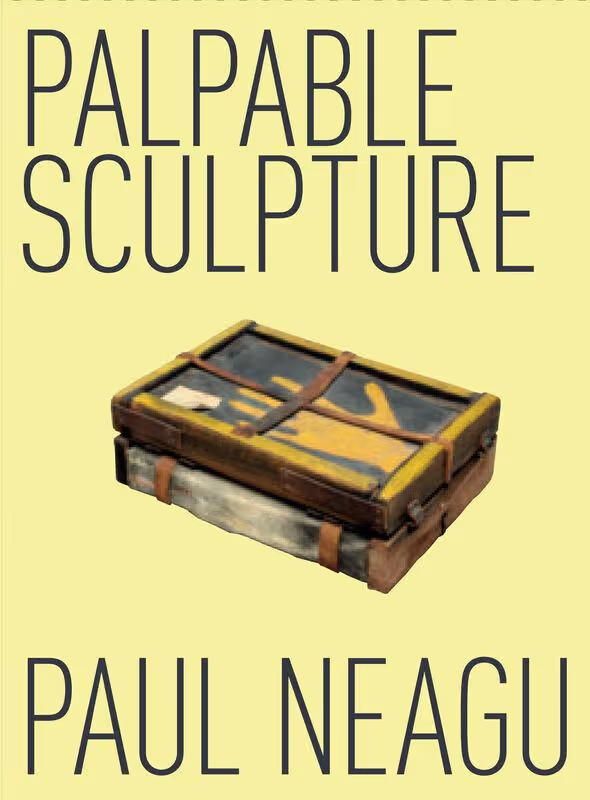
Paul Neagu: Palpable Sculpture
Published by Henry Moore Institute
Texts by Mel Gooding, Lisa Le Feuvre, Ileana Pintilie, Magda Radu, Jon Wood
On the occasion of the exhibition at Henry Moore Institute, Leeds, August–November 2015
Leeds, 2015
Artworks from
Public & Private
Collections
Special thanks to
MARe / Museum of Recent Art Collection
Andrei Jecza Collection
Anca and Mihai Oroveanu Collection
Paul Neagu Estate UK
Ivan Gallery Collection
Paul Neagu Estate RO
Ovidiu Șandor Collection
Volker Diehl Gallery Collection
Răzvan Bănescu Collection
The Anastasia Foundation Pinacotheca Collection
Mircea Pinte Collection
Avi Cicirean Collection
Larisa Sitar
Anca Oroveanu
Dan Vezentan
art supporters
Main Partner

partner

Supported by
The Location


Schedule
Saturday - 12:00 - 18:00
Sunday - 12:00 - 18:00
Address
Str. Duetului 54
Bucharest, Romania
Free access
Register here
You will receive the QR access code by sms and email. For security reasons all persons must be registered and all bags will be checked.